Key facts: Flood Cleanup
- Water that enters a home from outside is classed as Category 3 under the IICRC S500 standard because it can carry sewage, chemicals and soil organisms.
- Porous materials soaked by floodwater, such as carpet, pad and drywall, are generally removed rather than cleaned.
- Southern California's rainy season runs mostly from late fall through early spring, when atmospheric river storms can bring intense rain.
- Standard homeowners policies generally exclude flood; separate flood insurance is available through the National Flood Insurance Program and private insurers.
- FEMA's Flood Map Service Center shows the mapped flood zone for an address, including parts of the San Dieguito River valley.
In this page
- 1When indoor water counts as flood water
- 2Signs storm water has reached the inside of the house
- 3Why heavy rain finds its way into hillside estates
- 4How a flood scene is checked before cleanup begins
- 5Types of indoor flooding and what each usually involves
- 6How flood cleanup is done step by step
- 7What usually stays and what usually goes after floodwater
- 8Safe first steps after storm water gets in
- 9What to expect when a flood cleanup crew arrives
- 10Flood cleanup on large Rancho Santa Fe properties
- 11Preparing a Rancho Santa Fe estate for the rainy season
- 12Deciding what to keep after floodwater
- 13Problems that tend to follow indoor flooding
- 14A typical first week after storm water enters a home
- 15Protecting art, rugs and collections after storm water
- 16Flood cleanup questions asked in Rancho Santa Fe
What counts as a flood
When indoor water counts as flood water
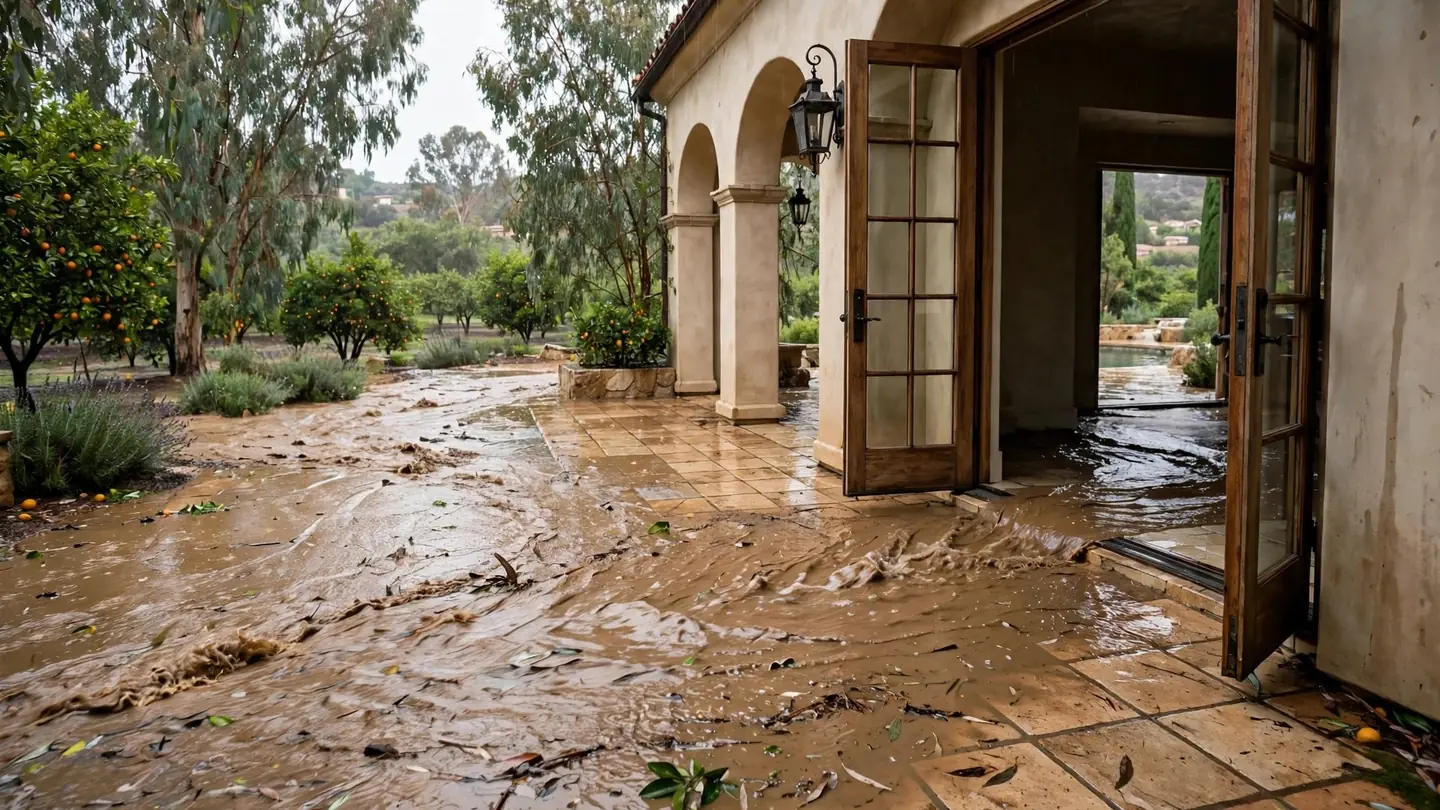
In restoration terms, a flood is water that enters the home from outside: rain runoff that sheets across a patio and under a door, a drainage swale that overtops, a creek or the river valley rising, or groundwater pushing up into a lower level. It is different from a leak inside the house because of what the water carries. Runoff picks up soil, fertilizer, animal waste, pool and landscape chemicals, and anything else on the ground it crossed.
Because of that, the IICRC S500 standard treats water from outside as Category 3, the most contaminated class. [1] That classification shapes everything that follows: which materials come out, how surfaces are cleaned, what protective gear the crew wears and how contents are sorted. It is also the reason flood cleanup is not a do-it-yourself job beyond the first safe steps.
The distinction matters for insurance too. Many homeowners policies treat water from a burst pipe and water from surface flooding very differently. Describing the source accurately, with photos showing where water came in, helps everyone understand the claim from the start.
In Rancho Santa Fe the most common indoor floods are not dramatic river events. They are smaller, faster incidents: a clogged courtyard drain during a cloudburst, a hillside that sends runoff toward a lower terrace, or a wine cellar or media room below grade that takes on water when soils are saturated.
How flooding shows up
Signs storm water has reached the inside of the house
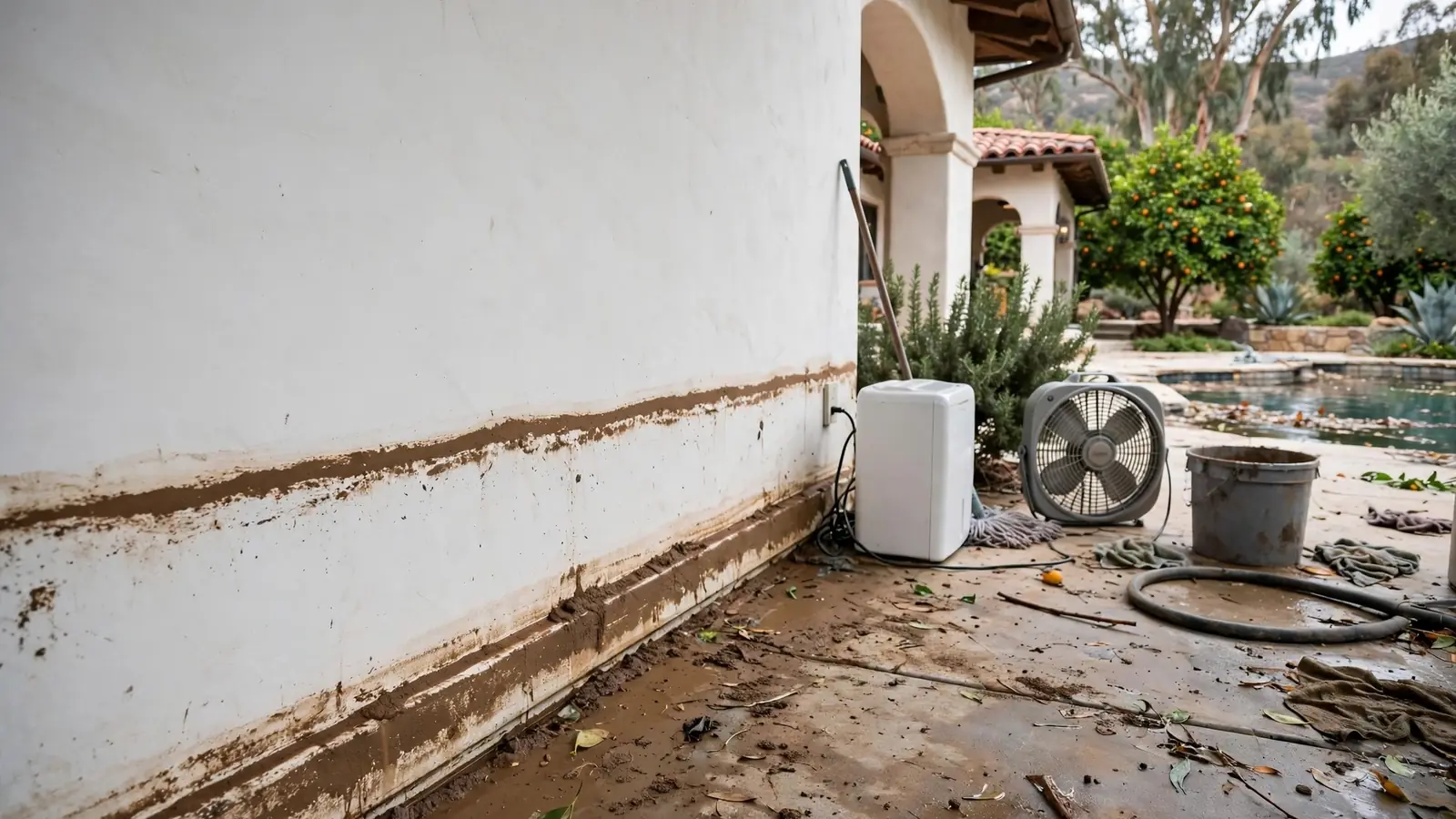
Silt line on walls
A thin brown line on drywall or baseboards marks how high water rose. It also shows how far contaminated water reached.
Mud at door thresholds
Mud tracked or washed in under French doors and sliders shows water came in at grade, usually from a patio or courtyard.
Wet carpet near exterior walls
Carpet that is wet along an outside wall with no plumbing nearby usually means water came through or under the wall.
Water in a lower level
Wine rooms, gyms and media rooms below grade can take on water through walls or floor joints after days of rain.
Earthy or sour smell
Floodwater smells different from clean supply water. A swampy odor is a sign of contamination and organic matter.
Pool or spa overflowing toward the house
When pool decks drain toward the house, an overflowing pool during a storm can push water against the foundation.
Why storms cause indoor flooding here
Why heavy rain finds its way into hillside estates
Southern California gets most of its rain in a few months, usually from late fall through early spring, and sometimes much of a season's total arrives in a few days of atmospheric river storms. The National Weather Service office in San Diego issues flood watches when these systems are forecast. [2] Soil that has been dry for months can shed water rather than soak it up at first, so runoff volumes surprise people.
Large estates often have big areas of hardscape: motor courts, terraces, pool decks and tennis courts. Every square foot of that surface sends water somewhere, usually into drains, swales and channels that rarely get tested between storms. Leaves, mulch and silt build up in those drains through the dry months. When the first big storm hits, a blocked inlet can turn a courtyard into a shallow pool in minutes.
Topography matters too. Homes on graded pads with slopes above them can receive runoff from neighboring property or the hillside itself. Homes on the valley floor near the San Dieguito River sit on lower ground where water collects. And any room below grade, such as a cellar or lower-level living space, depends on waterproofing and drainage that can fail when soil stays saturated.
Finally, wildfire history plays a part in parts of San Diego County. Burned slopes shed water and debris far more readily than vegetated ones. After a fire nearby, even a moderate storm can send mud toward homes downslope.
Safety and assessment
How a flood scene is checked before cleanup begins
- 1
Confirm it is safe to enter
If water is still rising, if there is any risk of a slope moving, or if emergency services have told people to stay away, nobody goes in. Ready.gov and the Red Cross stress staying out of floodwater.
- 2
Shut off power to wet areas
Electricity and floodwater are a deadly combination. Power to affected areas is cut at the panel by someone qualified, or by the utility if the panel itself is wet.
- 3
Identify the entry point
The crew traces how water came in, through a door, a wall, a floor joint or a drain, so it can be stopped before more rain arrives.
- 4
Measure the reach
Moisture meters and thermal imaging find how far water traveled under flooring and up walls, beyond the visible silt line.
- 5
Sort contents
Items touched by floodwater are separated into those that can be cleaned and disinfected and those that should be discarded.
- 6
Document the loss
Photos and video of every room, the silt line, the entry point and damaged contents are taken before removal starts.
Flood types
Types of indoor flooding and what each usually involves
| What happened | Where water usually enters | Typical cleanup focus |
|---|---|---|
| Courtyard or patio drain blocked | Under French doors and sliders | Flooring, baseboards, lower walls in rooms off the courtyard |
| Hillside runoff toward the house | Along the uphill wall, through weep screeds | Wall bases, carpet, the garage and mechanical rooms |
| Below-grade room taking on water | Through walls or the floor slab | Wine storage, gym or media room finishes, stored items |
| Driveway or motor court sheeting into the garage | Under the garage door | Stored items, garage walls, water heater base |
| Valley flooding on low ground | Across the whole lowest floor | Full lower-floor removal, contents, mechanical equipment |
| Pool or spa overflow during a storm | Pool-side doors and walls | Rooms facing the pool, decking drains, foundation edge |
The cleanup
How flood cleanup is done step by step
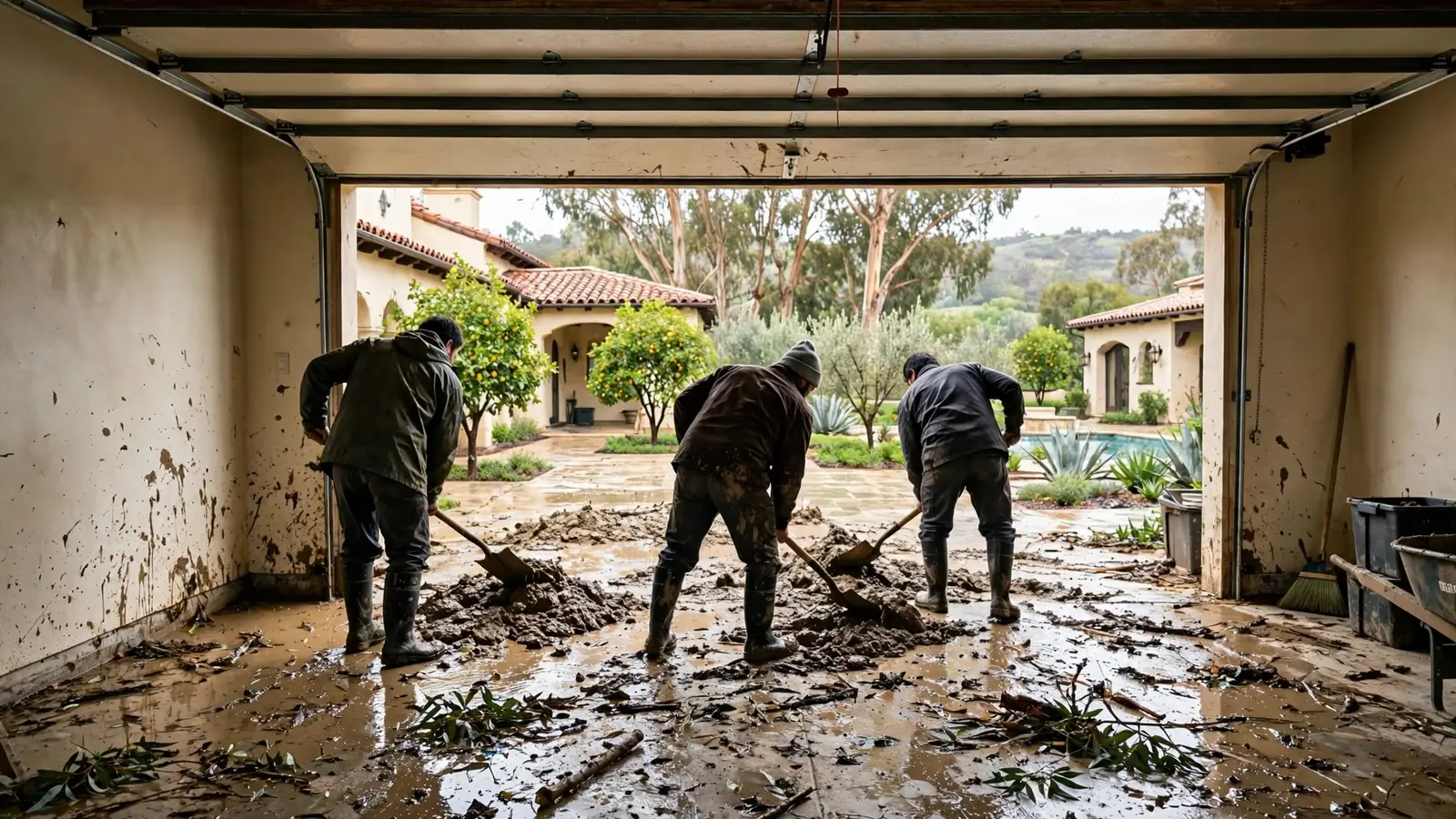
Flood cleanup begins with getting the bulk water and mud out. Pumps handle deep water, and extraction tools handle the rest. Mud and silt are shoveled and squeegeed out before they dry, because dried silt is harder to remove and spreads dust. Crews wear protective gear suited to Category 3 water, including gloves, boots and respiratory protection where needed, following the kind of hazard guidance OSHA publishes for flood cleanup. [7]
Porous materials that touched floodwater generally come out. That includes carpet and pad, drywall up to a measured height above the silt line, insulation in those wall bays, and often lower cabinets made of particleboard. Solid wood, stone and tile can usually be cleaned and disinfected. The exact cut line depends on moisture readings, not just the visible mark.
After removal, all remaining surfaces are cleaned and treated. That usually means washing with a detergent solution, then applying an antimicrobial to framing and slab surfaces. Contents that can be saved are cleaned separately, sometimes off-site.
Drying follows, with air movers, dehumidifiers and sometimes heat. Floodwater cleanup tends to need more equipment than a clean-water leak because more material has been removed and more structure is exposed. Drying continues until moisture readings match unaffected areas of the house, and only then does rebuilding start.
Materials after a flood
What usually stays and what usually goes after floodwater
| Material | Usual outcome | Why |
|---|---|---|
| Wall-to-wall carpet and pad | Removed | Absorbs contaminated water and cannot be reliably disinfected |
| Drywall below and slightly above the silt line | Removed | Paper facing and gypsum hold contamination and grow mold |
| Wet insulation | Removed | Holds water and contaminants inside the wall |
| Solid wood framing | Cleaned and dried | Can be washed, treated and dried to normal readings |
| Stone and ceramic tile | Cleaned and dried | Non-porous surface; grout and setting bed need checking |
| Upholstered furniture | Often discarded | Foam and fabric absorb floodwater; fine pieces may go to specialists |
| Hard furniture and metal items | Cleaned | Washed and disinfected; wood pieces dried slowly to avoid cracking |
| Documents and photos | Specialist recovery | Can be frozen and freeze-dried by document restoration services |
While you wait
Safe first steps after storm water gets in
Floodwater is not a good place to be. The safest first steps keep you out of it and protect what you can reach without wading through contaminated water.
If you have to enter a wet area, wear rubber boots and gloves, and wash thoroughly afterward. Keep children and pets away entirely.
- Stay out of water near outlets or appliances
- Move valuables upstairs or to dry rooms if safe
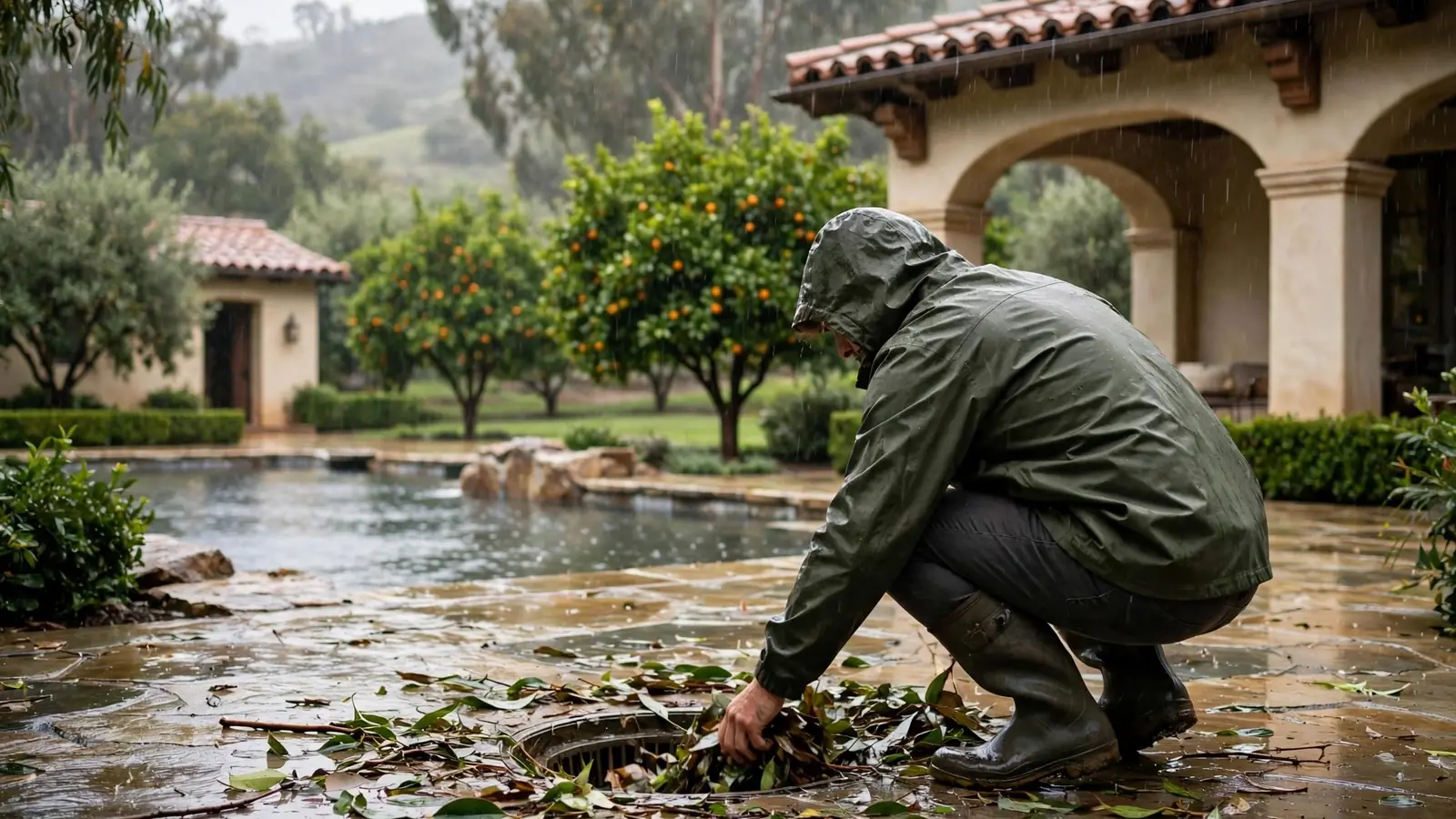
- Clear leaves from drains and inlets you can reach outside
- Photograph water, the silt line and the entry point
- Call your insurer to report the loss
Talk to a local contractor
Questions about flood cleanup?
One call connects you with an independent water damage restoration contractor who serves Rancho Santa Fe.
The visit
What to expect when a flood cleanup crew arrives
Flood cleanup visits are bigger than most leak jobs. Expect a truck with pumps and extractors, protective gear for the crew, plastic sheeting, containers for removed materials and a lot of drying equipment. In a large home, the crew may set up a staging area in the motor court or garage.
The lead will walk the property with you, inside and out. Understanding how water got in is as important as cleaning it up, because another storm may be days away. They may recommend temporary measures such as sandbags at a doorway, clearing a drain or diverting a downspout.
Removal of soaked materials usually starts on the first day. Ask the crew to photograph what they remove and any hidden damage they find. Flood claims involve a lot of paperwork, and those photos help.
Before leaving, the crew should explain the drying plan, how often they will return to take readings, and what you should watch for, such as a machine shutting off or a new leak during the next storm.
Rancho Santa Fe specifics
Flood cleanup on large Rancho Santa Fe properties
Many Rancho Santa Fe properties are large, landscaped and partly sloped, with private roads and gates. After a storm, access itself can be the first problem: a flooded low crossing, debris on a private drive or a gate that has lost power. Let the contractor know about access on your call so they can plan.
The valley floor along the San Dieguito River, where Fairbanks Ranch and parts of the surrounding area sit, is lower ground than the hillside communities. FEMA's Flood Map Service Center shows mapped flood zones by address. [3] If you are in or near one, it is worth knowing before the rainy season, and worth asking your agent about flood coverage, since standard homeowners policies generally exclude it.
Many local homes also have septic systems rather than sewer connections. Saturated ground can stop a leach field from draining, which can make household drains back up during long storms. That turns a storm-water problem into a sewage problem, covered on our sewage cleanup page.
Rebuilding after a flood may need permits from San Diego County Planning & Development Services, and exterior changes inside the Covenant may also need Rancho Santa Fe Association review. [10] Your contractor or builder can advise what applies.
Before the next storm
Preparing a Rancho Santa Fe estate for the rainy season
Most indoor flooding on estates starts with drainage that was never tested between storms. A pre-season check is the best defense.
- Have every area drain, courtyard inlet and channel drain cleaned and flow-tested before November
- Check that gutters and downspouts discharge well away from the foundation
- Inspect slopes, swales and retaining wall weep holes for blockage or erosion
- Keep sandbags or flood barriers on hand for doors that face a patio or slope
- Test sump pumps serving lower levels and consider a battery backup
- Look up your property on the FEMA flood map and review your flood coverage
Keep or discard
Deciding what to keep after floodwater
Because floodwater is contaminated, porous items rarely qualify for rescue. Carpet, pad, mattresses, upholstered furniture and drywall that soaked up floodwater are usually discarded. Trying to dry and keep them risks mold and leaves contamination in the house.
Hard items, such as solid wood furniture, stone, metal, glass and ceramics, can usually be cleaned and disinfected. Fine art, rugs, antiques and documents should go to specialists who work with flood-damaged collections. They can often save more than you would expect if they get the items quickly.
When in doubt, ask the contractor to explain their reasoning for each category of material. A good contractor will separate what must go for health reasons from what is a judgment call, and leave the judgment calls to you.
Often found together
Problems that tend to follow indoor flooding
Sewage backup
Saturated ground and overloaded septic systems can push wastewater back into the house during long storms.
Mold in lower walls
If drying is slow or incomplete, mold can grow inside wall cavities above the cut line.
Damaged mechanical equipment
Water heaters, HVAC equipment and pool pumps in low areas may need inspection before use.
Lower-level water intrusion
Below-grade rooms that flooded once tend to flood again until drainage and waterproofing are fixed.
The first week
A typical first week after storm water enters a home
- 1
Day one: water and mud out
Bulk water is pumped and extracted, mud is shoveled out before it dries, and the entry point is temporarily protected against the next band of rain.
- 2
Days one and two: controlled removal
Carpet, pad, drywall below the cut line and wet insulation are removed, bagged and hauled away, with photos of each room as walls are opened.
- 3
Day two: cleaning and treatment
Exposed framing, slab and remaining surfaces are washed and treated with an antimicrobial before any drying equipment is switched on.
- 4
Days two to seven: drying and readings
Air movers and dehumidifiers run continuously while a technician returns to log moisture readings and move equipment as areas dry.
- 5
End of the week: sign-off and handover
Once readings match unaffected rooms, equipment is removed and a drying record goes to you, your insurer and whoever handles the rebuild.
Collections and contents
Protecting art, rugs and collections after storm water
Many Rancho Santa Fe homes hold things that cannot be replaced: paintings, family archives, antique furniture, rugs and wine. Floodwater threatens these in two ways. Direct contact can stain, warp or contaminate them, and the humidity that follows a flood can damage pieces in rooms the water never reached. Moving vulnerable items to a dry, cool part of the house early is one of the most useful things you can do.
For anything valuable that did get wet, speed matters more than technique. Paper and photographs can often be frozen to halt damage until a document recovery service can freeze-dry them. Textiles and rugs should be lifted, kept flat and sent to specialist cleaners. Paintings should be kept face up and out of the sun, and assessed by a conservator before anyone attempts to clean them.
FAQ
Flood cleanup questions asked in Rancho Santa Fe
Is storm water really that contaminated?
Yes. Water that flows across ground picks up soil organisms, animal waste, fertilizers and chemicals. The IICRC S500 standard treats it as Category 3, the same class as sewage.
Can I just dry the carpet?
Not after floodwater. Carpet and pad soaked by water from outside are normally removed because they cannot be reliably disinfected.
How long does flood drying take?
Often several days to a couple of weeks depending on how much material was removed, the size of the space and the weather. Drying should continue until readings match dry parts of the house.
Does homeowners insurance cover floods?
Standard homeowners policies generally exclude flood. Separate flood insurance is available through the National Flood Insurance Program and private insurers. [4] Check your own policy.
Is my home in a flood zone?
FEMA's Flood Map Service Center lets you look up mapped flood zones by address. Low ground near the San Dieguito River is more likely to be mapped than hillside lots.
Is someone available during a storm at night?
Yes. The line on this site is answered around the clock, and your call connects you with an independent contractor who can talk through what to do right away.
Should I run my own fans?
Not until the contaminated water and soaked materials are out. Blowing air across contaminated surfaces can spread contaminants. Let the crew set up drying after cleanup.
What about my wine collection in a flooded cellar?
Bottles can usually be cleaned, but labels may be damaged. Photograph labels and the collection before moving it, and keep bottles cool and stable while the room is cleaned.
Sources and citations
- [1]IICRC S500 Standard for Water Damage Restoration
- [2]National Weather Service San Diego
- [3]FEMA: Flood maps
- [4]FloodSmart (National Flood Insurance Program)
- [5]Ready.gov: Floods
- [6]U.S. EPA: Flooding and your home
- [7]OSHA: Flood cleanup hazards
- [8]U.S. EPA: Mold cleanup in your home
- [9]Wikipedia: San Dieguito River
- [10]San Diego County Planning & Development Services