
Key facts: Hidden Moisture Behind Walls
- Wall cavities, subfloors and slabs can stay wet long after surfaces feel dry.
- Pin meters measure moisture in a specific spot; pinless meters scan an area without damage.
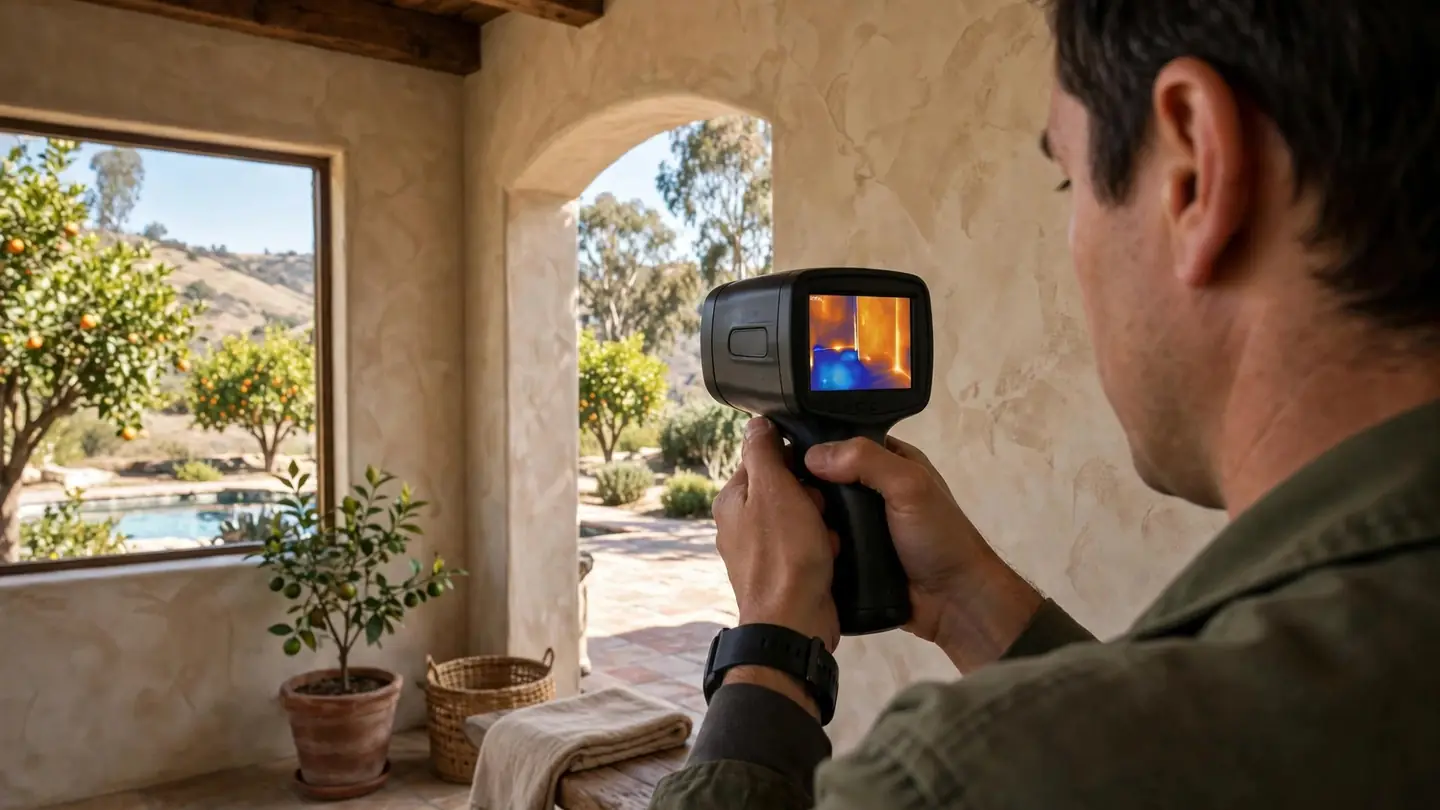
- Thermal cameras show temperature differences that can point to moisture but do not measure it directly.
- Wet cavities that stay damp beyond 24 to 48 hours give mold a chance to start, which is why the EPA stresses fast drying.
In this guide
- 1Why water hides inside walls and floors
- 2Clues that moisture is hiding somewhere
- 3How professionals find hidden moisture
- 4How a moisture survey is done
- 5What happens if hidden moisture is missed
- 6Thick walls and fine finishes in Rancho Santa Fe homes
- 7What happens once hidden moisture is found
- 8How common materials hold and release moisture
- 9When hidden moisture becomes a mold question
- 10Questions to ask about a moisture survey
- 11Moisture trapped above ceilings
- 12Hidden moisture questions
Why it hides
Why water hides inside walls and floors
Water moves by gravity and by wicking. Inside a wall, it runs down to the bottom plate and soaks upward into drywall. Under flooring, it spreads across the slab or subfloor. Insulation holds it like a sponge. Meanwhile, the room-side surface may dry quickly in the air, so the wall looks normal.
Some finishes make it worse. Vinyl wallpaper, gloss paint, sealed stone and thick rugs slow evaporation, so the material underneath stays wet. In large homes with built-ins, cabinetry and paneling, water can sit behind fixtures where nobody looks.
Clues
Clues that moisture is hiding somewhere
Baseboards swelling or separating
Swollen or gapped baseboards show the wall base is wet.
Paint bubbles or soft spots
Blistering paint or drywall that gives under a thumb are classic signs.
A smell that will not go away
A musty odor in one room can come from a wet cavity even when nothing is visible.
Floor movement weeks later
Hardwood that cups or gaps long after a leak points to moisture below.
Process
How a moisture survey is done
- 1
Start at the source
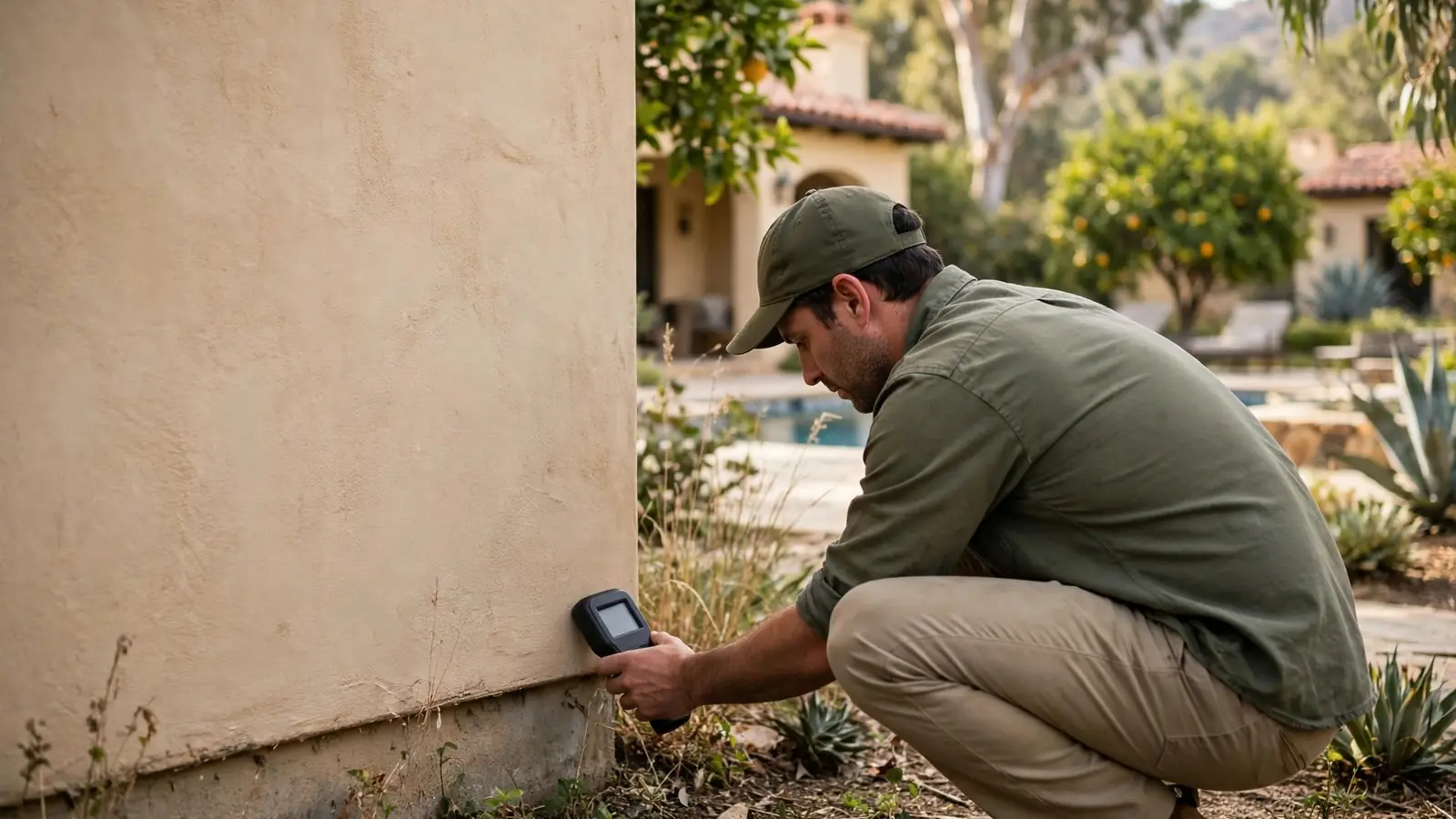
Readings begin where the water started and move outward in every direction.
- 2
Take dry reference readings
Similar materials in unaffected rooms set the standard for dry.
- 3
Mark the edges
Where readings drop to normal, the edge of the wet area is marked on a sketch.
- 4
Check behind obstacles
Cabinets, built-ins, toilets and appliances are checked around and behind.
- 5
Repeat during drying
The same points are measured on each visit until they reach the dry standard.
Rancho Santa Fe notes
Thick walls and fine finishes in Rancho Santa Fe homes
Spanish Colonial and Mediterranean-style homes often have thick plaster walls, sometimes over masonry. Plaster dries slowly and can hold moisture well after the surface looks fine, so readings matter more than appearance. Stone floors and wide-plank hardwood also hide moisture below.
Large homes with paneled libraries, built-in bars and extensive cabinetry have many places where water can sit unseen. Ask the contractor to check behind and under these, and to show you their moisture map.
Call about this problem
Questions about hidden moisture behind walls?
One call connects you with an independent water damage restoration contractor who serves Rancho Santa Fe.
Material behavior
How common materials hold and release moisture
| Material | Holds water | Dries |
|---|---|---|
| Drywall | Readily, wicks upward | Fairly quickly if open to air |
| Plaster over masonry | Moderately, deep in the wall | Slowly |
| Hardwood flooring | Absorbs from below | Slowly, may cup or crown |
| Concrete slab | Absorbs and holds | Very slowly under flooring |
| Fiberglass insulation | Traps water in place | Rarely dries in a closed wall |
Questions to ask
Questions to ask about a moisture survey
A short set of questions tells you a lot about how carefully a survey was done. Ask which meters were used and how dry reference readings were taken. Ask where the edges of the wet area were marked, and whether cabinets, built-ins and the ceiling below were checked. Ask how often readings will be repeated and what the target number is for each material.
If the answers are vague, ask to see the moisture map. A careful contractor will be glad to walk you through it room by room.
Ceilings
Moisture trapped above ceilings
Ceilings deserve their own mention. Water from a bathroom, a roof leak or an HVAC condensate line can pool on the top side of drywall and stay there, held by insulation. The first visible sign may be a faint ring or a slight sag. A thermal camera is especially useful here because it can scan a large ceiling quickly; any suspect area is then confirmed with a meter. A sagging ceiling should never be pushed or poked, since it can let go suddenly.