
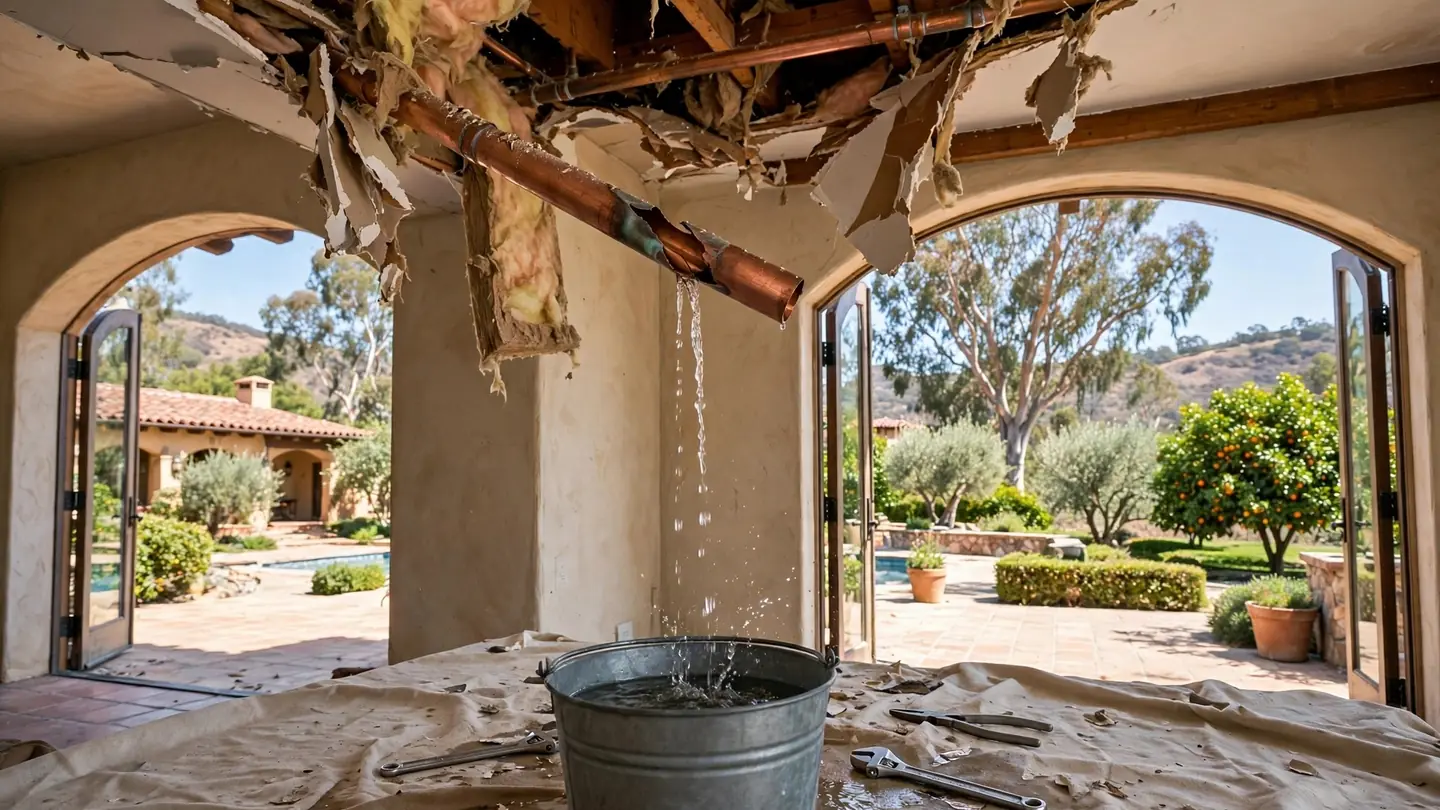
Key facts: Burst Pipe Water Damage
- A pressurized supply line can release a large volume of water in a short time until it is shut off.
- Pipes in coastal Southern California more often fail from pressure, corrosion, age or fittings than from freezing.
- Hard water can leave scale on valves and fittings and is a factor in some supply failures.
- Water from a supply line starts as Category 1 under the IICRC S500 standard but can degrade if it sits.
In this guide
- 1Why pipes burst in a mild climate
- 2Signs a pipe has failed out of sight
- 3What to do when a pipe bursts
- 4What a burst pipe does inside the structure
- 5Common pipe and fitting failures
- 6How burst pipe water is cleaned up and dried
- 7When the pipe that failed is under the slab
- 8Why a pressure check is worth doing after any burst
- 9Burst lines outdoors, at the pool and in irrigation
- 10Burst pipe questions
Why pipes fail
Why pipes burst in a mild climate
Water pressure is one common factor. Homes on hillsides or at the low end of a supply zone can see high incoming pressure, and a pressure regulator that has failed lets that pressure reach every fitting in the house. Sudden valve closures can also send a shock through the lines, known as water hammer.
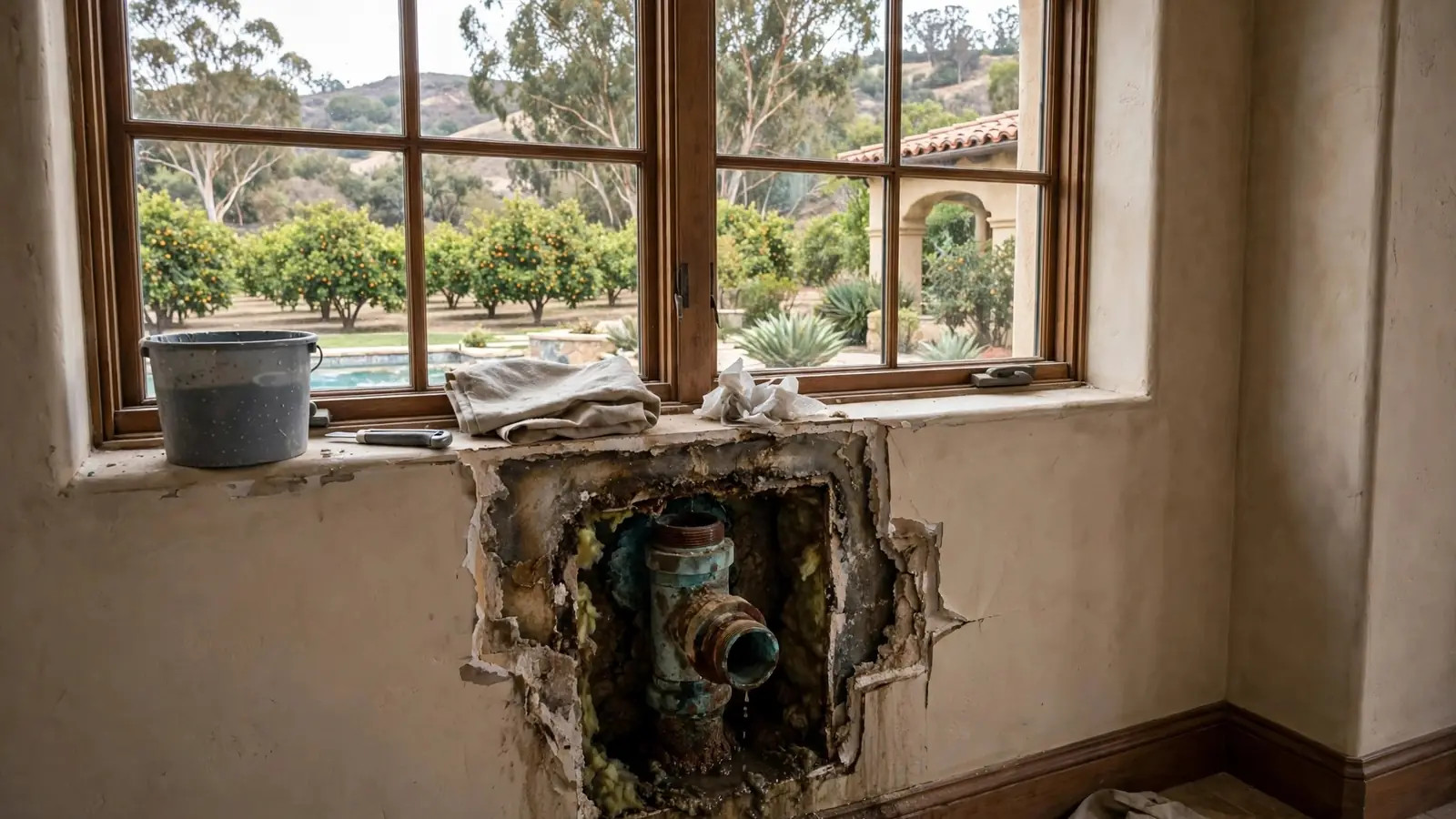
Age and material matter too. Older copper can develop pinhole leaks, galvanized steel corrodes from inside, and some plastic piping and fittings installed in past decades have known failure patterns. Push-fit and compression fittings, flexible supply lines and braided hoses all have a service life.
Hard water adds wear. The Santa Fe Irrigation District reports that its water is hard, and mineral scale builds up in valves, cartridges and fittings over time. [2] Ground movement and settling can stress pipes running through slabs or between buildings, and rare cold snaps can still damage exposed pipes on the outside of a house or at pool equipment.
Signs
Signs a pipe has failed out of sight
Sound of running water
Hearing water when every tap is off often means a supply line leak inside a wall, ceiling or under the slab.
Sudden drop in pressure
A noticeable pressure drop at fixtures can mean water is escaping somewhere upstream.
Ceiling stain or drip
A spreading stain, sagging drywall or a drip from a light fixture usually points to a pipe above.
Warm spot on a floor
A warm patch on a slab floor can mean a hot water line is leaking underneath.
Meter moving with no use
If the water meter keeps turning with everything off, there is a leak somewhere on the property.
When it happens
What to do when a pipe bursts
- 1
Shut off the main
A burst line is usually upstream of any fixture valve, so go straight to the main shutoff.
- 2
Kill power to wet areas
If water is running near electrical fixtures, switch off those circuits at a dry panel.
- 3
Open a low faucet
Opening a faucet on the lowest level helps drain the remaining water from the lines.
- 4
Catch and contain
Buckets under drips and towels along door thresholds slow the spread while you wait.
- 5
Call for help
You will need both a plumber for the pipe and a restoration contractor for the water damage.
Hidden damage
What a burst pipe does inside the structure
A pipe that bursts inside a wall or ceiling soaks the insulation and the back of the drywall first. Water then runs down to the bottom plate of the wall and spreads along the floor, under baseboards and into neighboring rooms. In a two-story home, water from a burst above can come through the ceiling and run down the inside of walls on the floor below.
Because the water is under pressure and released quickly, the wet area is often much larger than the visible damage. Moisture meters and thermal cameras are used to find its edges. Getting this mapping right is what separates a complete dry-out from one that leaves wet material hidden behind a finished wall.
Pipe types
Common pipe and fitting failures
| Material or part | Typical failure | Usual sign |
|---|---|---|
| Copper supply pipe | Pinhole leaks from corrosion | Slow drip, stain, damp drywall |
| Galvanized steel | Internal corrosion, rusted joints | Low pressure, rusty water, leaks at joints |
| Flexible supply line | Bulging or splitting with age | Sudden release under a sink or toilet |
| Pressure regulator | Fails open, letting pressure rise | Banging pipes, dripping relief valves |
| Pool and irrigation lines | Ground movement or cold snap | Wet ground, pressure loss outdoors |
Call about this problem
Questions about burst pipe water damage?
One call connects you with an independent water damage restoration contractor who serves Rancho Santa Fe.
Cleanup
How burst pipe water is cleaned up and dried
Clean water from a supply line is Category 1, so if the crew arrives quickly, many materials can be dried in place. Wet insulation usually comes out, drywall may be opened at the base or where the pipe is being repaired, and hardwood and stone floors are dried in place where readings allow.
The plumber and the restoration crew need to coordinate. The plumber needs access to the pipe, and that opening can double as an access point for drying the cavity. Once the pipe is fixed, drying runs until readings reach normal, then the wall is closed and finished.
Slab leaks
When the pipe that failed is under the slab
Many homes in the area are built on concrete slabs with supply lines running underneath or embedded in them. When one of those lines fails, there may be no dramatic burst at all: just a warm spot on the floor, a sound of running water, hardwood that starts to cup, or a meter that keeps turning. Water spreads under flooring across the slab before anyone sees it.
Slab leaks need a leak detection specialist to locate the failure, often with acoustic equipment, before a plumber decides whether to repair the line through the slab or reroute it overhead. The restoration contractor then dries the slab and flooring. Drying a slab takes longer than drying a wall, and flooring over it may need to be lifted for the slab to dry fully.
If you suspect a slab leak, close the main shutoff when you are not using water and watch the meter. If it still moves with everything off, call a plumber before the damage spreads further.
Pressure check
Why a pressure check is worth doing after any burst
After a pipe failure, ask the plumber to measure the static water pressure at an outside hose bib and to look at the pressure regulator. If pressure is high, the next weakest fitting may be the next to fail. Many plumbers also check the thermal expansion tank on the water heater, since a failed tank lets pressure spike every time the heater runs. These are quick checks that can prevent a repeat.
Outdoor lines
Burst lines outdoors, at the pool and in irrigation
Not every burst pipe is inside. Pool equipment, irrigation mains and lines feeding guest houses or barns run underground across large lots, and a break can flood a patio or push water against a foundation. Watch for wet ground that never dries, a sudden green patch in dry weather, or a pool that loses water faster than evaporation would explain.
FAQ
Burst pipe questions
Will my insurance cover a burst pipe?
Sudden and accidental pipe failures are often covered, while slow leaks over time often are not. Check your policy and report the loss promptly.
Do I need a plumber and a restoration contractor?
Usually both. The plumber repairs the pipe; the restoration contractor handles extraction, drying and any removal.
How do I prevent another burst?
Have a plumber check water pressure and the regulator, replace old supply lines, and consider an automatic leak shutoff.
Can water from a burst pipe cause mold?
Yes, if materials stay wet beyond a day or two. That is why prompt drying matters.